

The Morning Report, Chapter 1: Before Coffee
The Morning Report · chapter 1 · fiction
Names and places are fictional.
At 6:14 on a Saturday morning in November, Adam Kerr was still at the kitchen table in yesterday’s shirt.
He had tried the bed at one. He had tried the couch at half past two, with the TV on mute and a documentary about container ships he didn’t follow. At four he had made a pot of coffee, then poured it down the sink, because of rule four. Now his phone lay face down beside the salt shaker. He had stopped turning it over. She hadn’t written. She had said she wouldn’t.
Rain on the deck. The fridge humming. Somewhere down the hill a delivery truck reversing, beeping into the dark.
Then her key in the lock.
He didn’t get up. He had decided that around three: he would not go to the door like a dog. He heard her boots drop on the mat, one, then the other. The zip of her coat. The small sigh she always made when she hung her bag on the hook. Ordinary sounds. That was the worst of it, and the best.
Claire came into the kitchen in her stocking feet. The grey wool dress. Her hair had been up when she left; now it was down, and not the way she wore it down. She smelled of rain and of something he couldn’t place at first. Something sharp and resinous. Linseed oil. Cedar.
She looked at the coffee maker, rinsed and empty, and smiled a little.
"You remembered."
"Rule four." His voice came out rough. "Before coffee."
She pulled out the chair across from him, the one with the wobbly leg, and sat. She folded her hands on the table exactly the way she did on parent-teacher night.
"Okay," she said. "Do you want the report?"
Three weeks earlier
It had started with a game on her phone, which was the first strange thing, because Claire Doucet did not play games on her phone. She taught French to sixteen-year-olds at a high school in Halifax’s North End and confiscated phones for a living.
But that Friday the rain was coming sideways off the harbour, they had finished a bottle of red, and she had curled up at her end of the couch with her feet tucked under his thigh. "Mireille says this is good for couples." A truth-or-dare app. Black screen, white cards, a small meter at the top: LEVEL 1.
Level 1 was nothing. Truth: what did you notice first about your partner? Her laugh, across a crowded wedding reception, eleven years ago. Dare: kiss your partner somewhere that isn’t the mouth. She kissed the inside of his wrist, as if she were taking his pulse.
After seven cards the screen asked: Turn it up? She tapped yes before he could.
Level 2 was more. Dare: take off one thing your partner chooses. He chose her socks, like a coward. She rolled her eyes, reached under her sweater, unhooked her bra, pulled it out through her sleeve like a magic trick and dropped it in his lap. Dare: blindfold your partner with whatever is in reach and describe what you see. She used his navy scarf from the hook by the door. He sat in the dark of it while she described him: his ears going red, the vein in his neck, his hands not knowing where to go.
"You’re holding your breath," she said. "Breathe, Adam." The voice she used on her students before exams.
Turn it up? Yes.
The first card of Level 3 was a truth. What do you want that you have never dared to ask for?
He could have lied. Later he went over it a hundred times: he could have said a weekend in Quebec City, and she would have laughed and tapped the next card. Instead, because the scarf was still loose around his neck and her bare foot was against his hip and he’d had three glasses, he heard himself say it.
"I want to know that another man wants you. And I want you to let him."
The rain. The fridge.
"Say that again," Claire said.
He said it again, worse. That it wasn’t about her not being enough. That he’d thought about it for years. That he didn’t even need to see it. That the part he thought about was afterwards: her coming home, and telling him.
She put the phone face down on the coffee table. She stood, picked her bra off his lap with two fingers, walked into the bathroom and locked the door. He listened to the tap run for a very long time.
The rules
For six days she was perfectly polite.
She graded a stack of essays at the dining table with a red pen. She asked whether he’d called his mother. She slept on her side of the bed, facing the wall. On Wednesday he woke at three and found her awake too, looking at the ceiling, and neither of them said a word.
On Thursday she came home with a sheet of lined paper folded in four and set it beside his plate.
Her handwriting, round and quick. Five lines, the numbers circled in red.
1. You don’t watch. Not this time.
2. You don’t meet him. Not yet.
3. I choose who. I choose when.
4. You get a report. In the morning, at this table, before coffee.
5. Low tide. Either of us says it, everything stops. No questions that night.
He read it twice. "Low tide?"
"A safe word has to be something neither of us would ever say by accident." She said it lightly, as if she’d picked it up off the sidewalk on the way home. "Nobody says low tide in bed."
What stayed with him, later, was how little she had hesitated. Six days of silence, then five rules that fit together like a good joint. And number four. He had said afterwards. He had said telling me. He was almost sure he had never said before coffee. Before coffee was a phrase he had typed once, somewhere else, late at night, for people who didn’t know his name.
He told himself it was the kind of thing anyone might say.
"Number three," he said. "Do I get to know who?"
"You’ll get his name when I come home." She took the paper back, folded it and slid it into the pocket of her cardigan. "Ask me the question you actually want to ask."
"Are you doing this for me?"
She looked at him over the top of her glasses for a long moment.
"Ask me that in the morning."
Last night
She got ready with the bedroom door open, which was a message of its own.
He sat on the end of the bed and watched her do ordinary things in an extraordinary order. Black underwear he had never seen: plain, no lace, cut high on the hip. She had bought it, he understood, on some day while he was at work, a day when she had already decided. The grey wool dress that zipped up the back. She turned and lifted her hair, and he zipped her, and his hands were not steady. She noticed. She said nothing. One touch of perfume at the throat. Contacts instead of glasses, though she hated contacts.
"Who is he?"
"Morning." She glanced at her phone, one tap of the thumb, the screen dark again before he could see. "Don’t wait up."
"I’m going to wait up."
"I know you are," she said, and kissed his forehead as if he were the one going out.
The ferry took twelve minutes. Claire stood at the back, away from the other passengers, and watched her own reflection in the black window with the city lights behind it. A woman in a grey coat. A teacher. Somebody’s wife. On the Dartmouth side she walked four blocks of wet sidewalk to the end of a street of old houses, where a boatshed had been turned into a workshop, with one lit window upstairs.
She stood at the side door for a full minute with her hand raised. Her phone buzzed in her coat pocket. She didn’t take it out.
The door opened before she knocked.
Gabriel wore a dark shirt with the sleeves pushed up, and there was sawdust caught in the hair on his forearms. He was bigger than she remembered from the cove, or the doorframe made him bigger. Behind him rose a narrow staircase, and the smell came down it: cedar shavings, linseed oil, garlic in a pan.
"You came," he said.
"I said I would."
He stepped back to let her in. The hall was narrow, so she passed close, and she felt him very carefully not touch her.
At the foot of the stairs she stopped, close enough to smell the cedar on his shirt. His hand stayed on the banister. Hers stayed in her coat pocket, on the phone she wasn’t going to answer.
The report
"His name is Gabriel," Claire said.
Adam waited for the rest. A last name. Where. How long. He realized he knew nothing at all.
"Where did you meet—"
"That’s not in the report."
She told him about the stairs. About the apartment over the workshop: one long room under the roof beams, a wood stove, a table he had built himself, a bed at the far end behind a half-wall of shelves full of tools and paperbacks. He had made pasta. She had eaten half of it. They had talked about boats, which she knew nothing about, and about her students, which he asked about as though he really wanted to know.
"When did he kiss you?"
"He didn’t. I did." She turned her wedding ring with her thumb. She had kept it on. "I got up to take my plate to the sink and he got up too, and we were in each other’s way in his tiny kitchen, and I got tired of waiting."
Adam’s hand went flat on the table. She watched it.
"Keep going."
"He kisses slowly. Slower than you." She said it without cruelty, the way she’d write a comment on a report card, and it went through him like cold water. Under the cold water something else rose, and he hated it, and he did not want her to stop. "He held my face first. His hands are rough. He works with them. It felt like being held by someone who’s used to handling things that break."
"The dress."
"I turned around and lifted my hair. The way I did for you."
He closed his eyes.
"Open them," Claire said. "That’s the deal. You get the report, you look at me while I give it."
He looked.
She told him the zip went down one tooth at a time. That the wool slid off her shoulders and landed around her feet with a soft sound she would remember for the rest of her life. That she stood in the middle of that long room in the black underwear and nothing else, and Gabriel walked all the way around her, once, without touching her. That nobody had ever looked at her like that. That her knees went loose. That she wanted him to hurry, and wanted him never to hurry.
"Were you—" Adam’s voice cracked. He tried again. "Did you want him?"
"Before he’d even touched me." She held his eyes. "I was shaking. He noticed. He said my name, just my name, like a question, and I answered by unhooking my bra myself."
The fridge hummed. Adam realized he was gripping the edge of the table hard enough to hurt.
"He undressed me completely. Standing up. He went down on one knee for the last of it, slowly, and I had my hand in his hair so I wouldn’t fall over. Then he picked me up. I’m not light, Adam. He carried me to the bed like I was."
"And then?"
Claire was quiet. Outside, a grey line was coming up over the roofs.
"Up to the bed, you get everything. I decided that on the ferry. After the bed is mine."
"That isn’t one of the rules."
"It is now. Rule six."
The jealousy came up in him like nausea, and right behind it, tangled with it, the other thing, so strong his hands shook. "Did you think about me?"
"Once," she said. "At the door. Then not at all."
He pushed his chair back. It scraped on the tiles. He came around the table and she didn’t move. She sat very straight, hands still folded, and looked up at him.
"You can say it," she said quietly. "If you want this to stop."
He didn’t say it. He took her by the wrist, stood her up, turned her around. She lifted her hair without being asked. He found the zip.
"Like this?"
"Slower."
He did it slower. The wool fell to the kitchen floor. The black underwear, and her skin above it, and the smell of another man’s house on her neck. His hands were not steady at all.
"He went around me once," she said. "Go on."
He walked around her. The cold kitchen. The rain on the deck. His wife, in the grey light, in the middle of the floor where they made Sunday pancakes, not covering herself, watching him look. She was trembling again, and this time it was his doing, and she let him see it.
"Now you know what he saw," Claire said, and reached for his belt.
Her fingers were cold from the ferry and quick with the buckle, quicker than he had ever known them. He caught her face in both hands the way she had said Gabriel did, and she laughed against his mouth, a short surprised laugh, because he had never done that either. Then she stopped laughing. She pulled his shirt over his head and pressed her whole cold front against his chest, and he felt every breath she took.
He lifted her onto the edge of the table. The salt shaker went over. Neither of them looked at it. She hooked one heel behind his thigh and pulled him in, and when he kissed the side of her neck, right where the smell of cedar was, she made a sound he had never heard from her in eleven years: low, rough, almost angry.
"There," she said into his ear. "Like that. Don’t you dare be gentle with me this morning."
He wasn’t. She unhooked her bra herself, the way she’d told him, and dropped it on the floor beside the dress. Her nipples were hard against his palms and her skin was all gooseflesh, and she was shaking again. She guided him with one hand, her eyes open on his, and at the very first moment she held him there, still, her nails in his shoulder, and whispered his name like the answer to a question.
Then she let go.
The chair with the wobbly leg gave out somewhere after that. Later, neither of them could say exactly when.
At half past seven they were on the kitchen floor, on the grey wool dress, because it was the softest thing within reach. The rain had stopped. The tiles were cold under his back and her hair was stuck to his chest. She had a red mark on her hip from the edge of the table and she kept touching it, as if it surprised her.
"You were louder than me," she said at last.
"I was not."
"You were." She lifted her head and looked at him, and there was something in her face he had never seen at this table: not guilt, not pity. Curiosity. As if she had been studying him all night from the other side of the harbour and had just found what she was looking for. "Same time next week?"
He laughed until the dog next door started barking. She didn’t laugh. She was still watching him.
The text
At nine she went up to shower. Adam finally filled the kettle.
Her phone was on the counter beside the toaster, where she’d dropped it. It lit up while the water was coming to a boil. One line on the lock screen, from a contact saved only as G.
You were right about him. He waited up.
Adam read it twice. The kettle clicked off.
Of course she had guessed he would wait up. She knew him. But you were right meant she had said so to Gabriel. Before. Before the ferry, before the door. Somewhere, at some point he knew nothing about, his wife had described him to this man, and the man had been waiting to see if she was right.
He didn’t touch the phone. He stood there with the kettle in his hand until the screen went dark again.
Upstairs, the water stopped.
To be continued… Chapter 2. Next Saturday.
Names and places are fictional.
For you two
Play truth or dare tonight, on one phone, three levels, and add one rule of your own before the first card: anything confessed from Level 3 on gets no answer tonight. The one who heard it answers the next morning, at the kitchen table, before coffee. A night to think makes the answer kinder, and breakfast a lot more interesting.
Play Truth or dare on sharegf: free, in your browser, three levels, and a "Stay here" button for whenever one of you wants to stop climbing.
For the blindfold dare
A scarf works. If you want the real thing, this kit comes with a satin blindfold, plus cuffs for a later level.
Overview based on manufacturer info, not a hands-on test · partner links
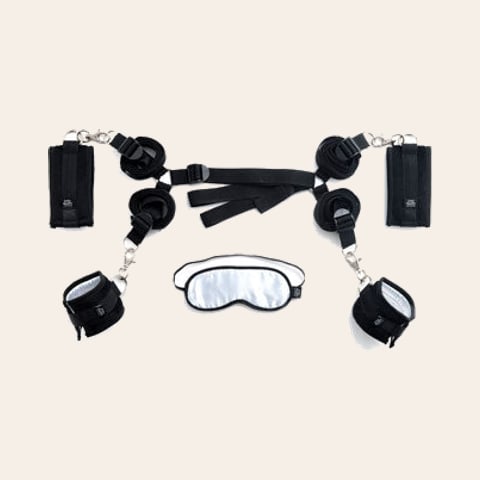
Fifty Shades of Grey — Hard Limits
For: Couples ready for new rules
Control: Adjustable straps, satin wrist and ankle cuffs, a blindfold
- Pro: Fits most beds, a chair or a door
- Pro: Storage bag included
- Con: Agree on a safe word before you start
Price: see intimatify.com (it changes often)